
Maryland MVA Motorcycle Practice Test 39
- Questions25
- Correct to pass21
- Passing score84%
- Minimum age15 years 9 months
-
1. Why do safety agencies put head protection first among riding gear?
Show answer
Answer A: Because head injuries are the leading cause of death in motorcycle crashes
Head injury is the most common cause of death in motorcycle crashes, which is why a certified helmet is the single most important piece of gear.
-
2. A pedestrian is crossing a wide four-lane street and has reached the lanes on the far side. When may you go on?
Show answer
Answer C: Only after the person has finished crossing the roadway
Waiting until the pedestrian has finished crossing is correct in every state and removes any doubt about how much clearance your state demands.
-
3. When are points assessed for an ordinary Maryland handheld telephone violation?
Show answer
Answer D: Only when the offense contributes to a crash
Maryland bars point assessment for a handheld telephone violation unless the offense contributed to an accident, leaving the escalating fines as the ordinary penalty.
-
4. A law enforcement officer is directing traffic and waves you forward while the signal facing you shows red. What should you do?
Show answer
Answer A: Follow the officer's direction and proceed
Directions given by an officer controlling traffic take priority over signals, signs and pavement markings.
-
5. Compared with dry pavement, how much room does a vehicle need to stop on packed snow?
Show answer
Answer D: Several times as much
Grip on packed snow is a fraction of that on dry pavement, so stopping distance grows several times over. Antilock brakes help you steer, not stop shorter.
-
6. Why must a tank bag be strapped down properly rather than simply laid on the tank?
Show answer
Answer D: Because a bag that slides can reach the controls or your hands
Braking pushes anything loose on the tank forward toward the handlebars, where it can jam the steering or interfere with the levers.
-
7. For an alert driver, about how long is the reaction time once a hazard has been recognized?
Show answer
Answer A: About three quarters of a second
Reaction alone takes roughly three quarters of a second for an alert driver, and perception takes about as long again, so a second and a half of travel is added before the brakes bite.
-
8. A notification appears on your smart watch while you are driving. What should you do?
Show answer
Answer B: Treat it as you would a phone and leave it
A watch screen demands the same eyes and the same attention as a phone, and a wrist is no safer a place to read a message than a dashboard.
-
9. An oncoming vehicle keeps its high beam on and dazzles you. What should you do?
Show answer
Answer C: Look toward the right edge of your lane and slow until it has passed
Shifting your gaze to the right edge of the lane keeps you on line without staring into the glare, and slowing gives you time if something is hidden in it.
-
10. How may a Maryland court respond to a first handheld telephone offense?
Show answer
Answer B: It may waive the penalty if the driver proves a hands free accessory was obtained
Maryland lets the court waive the penalty for a first offense if the driver shows proof of acquiring a hands free accessory, attachment, add-on or built-in feature.
-
11. You enter a corner faster than the turn can be taken. What is the most likely result?
Show answer
Answer A: The vehicle runs wide and may cross into another lane
Excess speed uses up the available grip, so the vehicle follows a wider arc than intended and drifts out of its lane.
-
12. How does the crown of a road affect a turn made on it?
Show answer
Answer C: Turning toward the low side leaves less ground clearance for leaning
Leaning down the slope of the crown adds the slope to the lean angle, so the footrests and other parts reach the pavement sooner than they otherwise would.
-
13. What does Maryland law say about driving too slowly?
Show answer
Answer A: A driver may not willfully impede the normal and reasonable movement of traffic
Maryland prohibits willfully driving so slowly as to impede the normal and reasonable movement of traffic, unless the reduced speed is needed for safety or required by law.
-
14. The signal ahead turns yellow while you are approaching it. What does the yellow light mean?
Show answer
Answer C: The red is coming; stop if you can do so safely
A steady yellow warns that the red is next. Stop if you can do so safely; enter the intersection only when stopping would be dangerous.
-
15. You are waiting to turn left and an oncoming vehicle stopped in the near lane to turn left blocks your view of the far lane. What should you do?
Show answer
Answer A: Wait where you are until you can see that the far lane is completely clear
The lane you cannot see is where the crash comes from, so you hold your position until the view opens up.
-
16. Which statement best describes what the basic speed law requires of you?
Show answer
Answer C: That you never drive faster than is reasonable and safe for the conditions
Nearly every state has a basic speed law that makes the conditions the real limit: weather, traffic, light and road surface can all require a speed well below the posted number.
-
17. Your left-turn lane faces a steady green ball and oncoming traffic is heavy. What are you allowed to do?
Show answer
Answer C: Move into the intersection and turn when a safe gap appears
A green ball permits the turn but gives no priority, so you may move into the intersection and wait there for a gap in the oncoming traffic.
-
18. School warning signs use which background and legend colors?
Show answer
Answer A: A black legend and border on a fluorescent yellow-green background
School warning signs carry a black legend and border on a fluorescent yellow-green background, a shade chosen so they stand out from ordinary yellow warning signs.
-
19. On which Maryland highways may a work zone speed control camera be used?
Show answer
Answer A: Where the limit posted before the work zone began was 45 miles per hour or more
Maryland allows a work zone speed control system only on a highway whose pre-existing posted limit, set by accepted engineering practice, was 45 mph or greater.
-
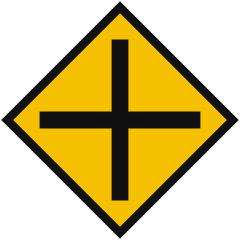
20. What should a driver expect a short distance beyond this sign?
Show answer
Answer C: Another road crossing the one being traveled
Traffic may enter or cross from either side at the intersection ahead, so the driver should ease off, cover the brake and check both approaches.
-
21. You are approaching a marked school crossing and children have started to cross the roadway. What is required?
Show answer
Answer A: Stop and let the children finish crossing the roadway
Drivers give way to people in a marked crossing, stopping if that is what it takes, and children in particular may change direction without warning.
-
22. You are riding a shaded back road in autumn and reach a mat of wet leaves covering the pavement. What should you expect?
Show answer
Answer D: Traction can be nearly as poor as ice, so slow down before you reach them
Wet leaves are slick and they hide whatever is underneath, so reduce speed before the patch and cross it upright without braking or turning.
-
23. How can you keep space at the sides of your vehicle in heavy traffic?
Show answer
Answer D: Drive in the gaps between the other vehicles rather than beside them
Travelling in the open spaces rather than alongside others keeps a way out open on at least one side.
-
24. You leave a brightly lit service area onto a dark rural road. Why should you slow down for a while?
Show answer
Answer C: Your eyes need time to adjust, so at first you see less
Eyes take a few minutes to adapt from bright light to darkness, and during that time you can see much less than your headlights actually show.
-
25. You are waiting to turn and the traffic ahead has stopped. Where must you not come to rest?
Show answer
Answer D: On the crosswalk, which people need in order to cross the street
Stopping on a crosswalk forces pedestrians out into the traffic lanes to get around you, so you hold back before it instead.