
Maryland MVA Motorcycle Practice Test 38
- Questions25
- Correct to pass21
- Passing score84%
- Minimum age15 years 9 months
-
1. A set of reversible express lanes is closed off with gates and signs while it runs the other way. What must you never do?
Show answer
Answer C: Enter past a closed gate or a sign showing the lanes are closed
When reversible lanes are closed they may already be carrying traffic in the opposite direction, so entering past a gate can put you head-on into that traffic.
-
2. The vehicle you have borrowed is larger and heavier than your own. How should you drive it?
Show answer
Answer B: Allow more room for stopping and for turns until you are used to it
Extra weight and length mean longer stopping distances and wider turns, so give yourself more room until you are used to it.
-
3. You realize your tires are running on ice. Which set of inputs is safest?
Show answer
Answer C: Gentle steering, no sudden braking, and no sudden acceleration
Whatever grip is left is used up at once by any sudden input, so every movement of wheel, brake and accelerator must be slow and small.
-
4. You want to turn right from a lane marked for through traffic and right turns, and the driver behind you wants to go straight. What should you do?
Show answer
Answer C: Signal, stay in the lane and make the turn when it is safe
A shared lane is the correct place to turn right from, so signal early and turn from the lane; the driver behind must wait or use another lane.
-
5. How many points does Maryland assess for failing to stop for a steady red traffic signal?
Show answer
Answer C: 2 points
Maryland assesses 2 points for failing to stop at a steady red signal or at a traffic control signal that is not functioning.
-
6. Why is it useful to watch the vehicle two or three places ahead of you?
Show answer
Answer C: You get an earlier warning of slowing traffic than brake lights give
Trouble travels back through a line of traffic, so seeing it start several vehicles ahead gives you a head start on braking.
-
7. Parked cars block your view of a cross street you are about to enter. How should you proceed?
Show answer
Answer A: Edge forward slowly until you can see along the cross street, then go
Creeping forward buys a view of the cross street a little at a time, and it keeps the rider slow enough to stop if something is coming.
-
8. A driver ahead brakes for no reason you can see, again and again. What should you do?
Show answer
Answer B: Increase your following distance and be ready for yet another stop
Unexplained braking tells you the driver is unsure or distracted, so the safe answer is more room, not less.
-
9. Where does a rider find the correct chain slack figure for a particular motorcycle?
Show answer
Answer B: In the owner manual for that motorcycle
Correct slack varies from model to model, so the manufacturer specification in the owner manual is the only reliable figure.
-
10. You come around a bend and find loose sand spread across your lane. What should you do?
Show answer
Answer D: Ease off the gas, avoid sudden braking or steering, and keep straight
Loose material acts like ball bearings under the tires; smooth inputs preserve what little grip remains, while sudden braking or steering breaks it.
-
11. A steady downward green arrow is displayed over a lane. What does it indicate?
Show answer
Answer C: The lane is open to traffic in your direction
A steady downward green arrow means the lane it points to is open to traffic traveling in your direction.
-
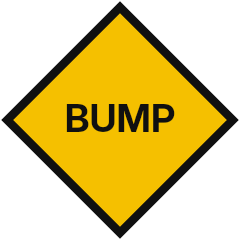
12. Why does this warning matter more on a motorcycle than in a car?
Show answer
Answer B: Because a sudden jolt can unsettle a two-wheeled machine and the rider can lose control
A jolt can push a motorcycle off line or lift a wheel, so a rider slows early, comes slightly off the seat and keeps a relaxed but firm hold on the handlebars.
-
13. A broken white line separates your lane from the lane on your right. What does it permit?
Show answer
Answer C: Changing lanes when it is safe to do so
A normal broken white line marks a boundary between lanes traveling the same way that road users may cross when it is safe.
-
14. Why does a motorcycle feel less stable at very low speed when a passenger is aboard?
Show answer
Answer B: The passenger's weight sits high and to the rear, so balance is easier to upset
A second person adds mass above and behind the rear axle, so slow speed maneuvers such as pulling away, walking pace turns and stops demand more care.
-
15. At an intersection where turning on a red arrow is not permitted, the signal shows a red left arrow next to a steady green ball. What may you do?
Show answer
Answer D: Go straight or turn right if permitted, but not left
An arrow controls only the movement it points to, so here the red arrow stops the left turn while the green ball still allows the other movements.
-
16. Why should a rider reduce speed at night even on a familiar road?
Show answer
Answer C: So the stopping distance stays inside the distance the headlight lights up
At night you can only react to what the headlight shows, so keep your speed low enough that you can stop within the lit distance ahead.
-
17. You realize you have just gone past your exit on a freeway. What should you do?
Show answer
Answer C: Carry on to the next exit and turn around there
A missed exit costs a few minutes, while backing up or cutting across the striped gore area puts you in the path of traffic that is not expecting it.
-
18. Which feature matters most in clothing meant to keep a rider warm?
Show answer
Answer C: A windproof outer layer, since moving air strips body heat fast
Wind blowing through clothing carries away heat faster than anything else, so a windproof outer shell over insulating layers is what keeps a rider warm.
-
19. How long does Maryland suspend a driver's license for a first refusal to take a chemical test?
Show answer
Answer B: 270 days
Maryland suspends the license for 270 days on a first test refusal, a longer period than the 180 days imposed for a first result of 0.08 or more.
-
20. A school sign paired with a plaque showing a diagonal downward-pointing arrow is installed
Show answer
Answer D: at the school crossing itself, or as close to it as possible
The diagonal downward arrow points at the crossing, so this assembly is placed at the crossing location rather than in advance of it.
-
21. A bicyclist is riding in the middle of a narrow travel lane ahead of you. What is the correct response?
Show answer
Answer D: Slow down and wait until you can pass with wide clearance, changing lanes if needed
A bicyclist has the same right to use the lane as a driver, and a narrow lane may not leave safe passing room, so wait for a gap that lets you move over and pass with a wide margin.
-
22. How does Maryland assess points when one incident produces convictions on several charges at once?
Show answer
Answer C: Only the charge carrying the highest assessment produces points
Maryland assesses points only on the charge with the highest assessment when the convictions arise from offenses at the same time and place.
-
23. A person with a guide dog is standing at the corner facing the street you are about to cross. What should you do?
Show answer
Answer D: Stop well back and wait quietly for them to decide
Blind pedestrians rely on engine sound to judge traffic, so stop back from the crossing and avoid the horn, which only confuses them.
-
24. A helmet falls from the seat onto a hard floor but shows no cracks. What should the owner do?
Show answer
Answer C: Replace it or have it checked, because the liner can be crushed inside
The foam liner can be compressed with no outside sign, and crushed foam will not absorb a second impact, so a helmet that has taken a hard knock should be replaced.
-
25. A friend asks for a ride and has no gear at all. What is the correct approach?
Show answer
Answer A: Provide a certified helmet, eye protection and covering clothing
A passenger hits the ground the same way the rider does, so a passenger needs the same protection: a certified helmet, eye protection, gloves, boots and covering clothing.