
Maryland MVA Motorcycle Practice Test 34
- Questions25
- Correct to pass21
- Passing score84%
- Minimum age15 years 9 months
-
1. A bee gets inside your jacket while you are riding. What is the recommended action?
Show answer
Answer B: Pull off the road and stop before you try to deal with the insect
Being stung hurts, but losing control while swatting hurts much more, so ride to a safe place, stop and then deal with the insect.
-
2. You are overtaking in a short passing lane on a two-lane road and it is about to end. What must you do?
Show answer
Answer A: Finish the pass and move back to the right before it ends
The added lane ends and the traffic returns to a single lane in each direction, so the pass has to be complete before the pavement runs out.
-
3. Which of these is checked in the Chassis step of T-CLOCS?
Show answer
Answer C: The frame, the suspension, the chain or belt and the fasteners
The chassis step covers the frame and its welds, the front and rear suspension, the final drive and the nuts and bolts holding everything together.
-
4. How many points does Maryland assess for causing a death or serious bodily injury through a phone or texting violation?
Show answer
Answer D: 12 points
Maryland places this offense in its 12 point band, the level at which the Administration moves to revoke a license.
-
5. A person using a wheelchair is waiting to cross at a corner ahead. How should you treat that person?
Show answer
Answer B: As a pedestrian with the right of way at the crossing
A wheelchair or a mobility scooter user has the rights of a pedestrian, so yield the whole crossing and wait until the crossing is finished.
-
6. How should a rider use a motorcycle fitted with antilock brakes in an emergency stop?
Show answer
Answer D: Apply firm, steady pressure to both brakes and keep it there
An antilock system releases and reapplies pressure far faster than a rider can, but only while the rider keeps holding the brakes on.
-
7. What should be adjusted on the motorcycle before carrying a passenger?
Show answer
Answer C: The suspension and the tire pressure, following the owner's manual
The extra weight compresses the suspension and loads the tires, so both should be set to the values the manufacturer specifies for riding with a passenger.
-
8. Just before the front wheel reaches an obstacle, what should you do with the throttle?
Show answer
Answer C: Roll it on slightly to lighten the front end
A small amount of throttle shifts weight rearward and lightens the front wheel so it rides over the obstacle more easily.
-
9. A passenger is getting on at the roadside. Which side should they use if the exhaust and the sidestand allow it?
Show answer
Answer B: The side away from moving traffic, clear of the hot exhaust
Getting on and off away from passing vehicles keeps the passenger out of traffic, and the side chosen must also keep their leg clear of the hot exhaust.
-
10. The red lights on a stopped school bus go out and the bus begins to move away. What should you do?
Show answer
Answer B: Move off slowly and keep watching for children near the road
Children who have just left the bus may still be near the roadway or crossing behind it, so pull away gently and keep looking for them.
-
11. You are approaching a yield sign and no other vehicle is anywhere in sight. What does the sign require?
Show answer
Answer A: Slow down and be ready to stop, but stop only if needed
A yield sign requires you to slow and give way, and to stop only when traffic or pedestrians make stopping necessary.
-
12. After turning right you see a sign showing that your lane ends a short way ahead. What should you do?
Show answer
Answer B: Signal and merge into the next lane while there is still room
Merge early and smoothly while a gap is still available, rather than running out of pavement or forcing your way in at the last moment.
-
13. When is passing another vehicle on the right generally permitted?
Show answer
Answer C: When the road has two or more lanes in your direction, or the vehicle ahead is turning left and there is room without leaving the pavement
Passing on the right is limited to situations where a lawful lane exists for it or the vehicle ahead is turning left, and it may never be done by driving onto the shoulder.
-
14. You stop at a rest area because you are sleepy. How long a nap is usually recommended?
Show answer
Answer D: About fifteen to twenty minutes
A short nap of fifteen to twenty minutes restores useful alertness without leaving the grogginess a longer sleep can bring, and you should wait a few minutes before driving on.
-
15. Why should you stay out of an intersection you cannot clear, even on a green light?
Show answer
Answer B: Because you would block cross traffic when their signal turns green
A vehicle stranded in the intersection blocks the cross street when its light turns green, which stalls the whole junction and traps emergency vehicles.
-
16. A dog runs out and chases your motorcycle. What is the recommended response?
Show answer
Answer D: Downshift and approach slowly, then accelerate away as you reach the animal
Approaching slowly keeps the dog aiming at where you are now, and accelerating as you reach it leaves the animal behind without a sudden swerve.
-
17. Which ability does alcohol usually affect first?
Show answer
Answer A: Judgment and self control
Alcohol reduces judgment and inhibition before a drinker notices any clumsiness, which is why an impaired driver often feels perfectly capable while already driving worse.
-
18. Why is following distance measured in seconds rather than in car lengths?
Show answer
Answer A: Because a time gap automatically grows with speed, while a fixed number of car lengths does not
A gap counted in seconds keeps the same margin of reaction time at any speed, whereas a fixed number of car lengths becomes far too small as speed rises.
-
19. The lane you are in is marked with a straight arrow and a right-turn arrow together. What does that mean?
Show answer
Answer D: Drivers in that lane may either go straight or turn right
A lane marked with two arrows serves both movements, so a driver in it may take either one.
-
20. A driver in the leftmost lane reaches this sign at an intersection. What must the driver do?
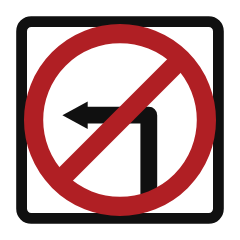
Show answer
Answer B: Go straight on or turn right, and reach the destination another way
The restriction holds whatever the traffic or the signal is doing, so the driver has to pass the intersection and plan a different route.
-
21. How should a rider adjust speed on an unlit road at night?
Show answer
Answer C: Slow enough to stop within the distance the headlight actually lights up
A rider can only react to what is visible, so night speed has to fit the distance the headlight reaches rather than the posted limit.
-
22. There is a stop sign but no stop line and no crosswalk. Where must you stop?
Show answer
Answer A: Before entering the intersection, where you can see cross traffic
With no line or crosswalk, stop before you enter the intersection at the point where you can see traffic on the cross street.
-
23. A lane along the right edge is set off by a solid white line and marked with a bicycle symbol. How should a driver treat it?
Show answer
Answer B: Stay out of it except for the short distance needed to turn or cross where that is allowed
A marked bicycle lane is set aside for bicycle traffic, and motor vehicles may enter it only briefly where turning or crossing is permitted.
-
24. Which items belong to the Controls step of the T-CLOCS inspection?
Show answer
Answer D: Handlebars, levers, cables, hoses and the throttle
The Controls step covers everything the rider operates by hand or foot, plus the cables and hoses that carry those inputs to the machine.
-
25. Where do the greatest number of collisions involving motorcycles occur?
Show answer
Answer D: At intersections
Intersections concentrate crossing and turning paths, and the most common single event is a car turning left across the path of an oncoming motorcycle.