
Maryland MVA Motorcycle Practice Test 32
- Questions25
- Correct to pass21
- Passing score84%
- Minimum age15 years 9 months
-
1. A white diamond symbol is painted in a highway lane. What does it identify?
Show answer
Answer C: A lane reserved for high-occupancy vehicles
The diamond symbol marks a preferential lane, most often one reserved for vehicles carrying a minimum number of occupants.
-
2. What does research say about the effect of a full coverage helmet on a rider's ability to see and hear traffic?
Show answer
Answer B: It leaves the view and the useful hearing a rider needs largely intact
Certified helmets leave far more peripheral vision than a rider needs to check traffic, and riders wearing them still hear the sounds that matter.
-
3. Enhanced reference location markers differ from ordinary mileposts in that they
Show answer
Answer B: carry the route number and a mileage figure to the tenth of a mile
An enhanced reference location marker adds the route designation and carries the mileage to a tenth, so the point named is far more precise than a plain milepost.
-
4. May you park at the curb immediately next to a railroad crossing?
Show answer
Answer A: No, you must leave the crossing and its approach clear
Parking beside a crossing hides the tracks and the signals from approaching drivers and leaves no room for a vehicle that has to clear the rails.
-
5. You want to turn right at a steady red light and no sign prohibits the turn. What is required?
Show answer
Answer B: Come to a complete stop, then yield to traffic and pedestrians before turning
A right turn on a steady red is permitted only after a complete stop and only after yielding to cross traffic and to pedestrians, and a posted sign can prohibit it entirely.
-
6. A driver reaching a stop sign is required to do what?
Show answer
Answer D: Come to a complete stop and then proceed only when it is safe
A stop sign requires a full stop before the stop line, crosswalk or intersection, after which the driver may go on once the way is clear.
-
7. Which sign shape is reserved for one message only, the requirement to stop?
Show answer
Answer A: The octagon
The octagon is used for the stop sign and for no other message, so the outline alone identifies the requirement even when the legend is hard to read.
-
8. A center lane is marked with a broken yellow line on each side and is controlled by overhead lane signals. How is that lane used?
Show answer
Answer A: It carries traffic one way or the other according to the signals
A reversible lane is marked with broken yellow lines on both sides and its direction of travel is set by the lane control signals above it.
-
9. You must stop for a train at a highway-rail crossing. Where should you stop?
Show answer
Answer B: Behind the stop line, gate or signal and well clear of the nearest rail
Stop behind the stop line, gate or flashing-light signal and well clear of the nearest rail, because a train overhangs its track by several feet on each side.
-
10. An obstacle appears ahead and you can see there is no room left to stop before it. What should you do?
Show answer
Answer D: Swerve around it
Once the distance is too short to stop, changing direction is the only option left, and a motorcycle can change direction faster than it can stop.
-
11. On dry pavement in good weather, what is the smallest following gap you should keep?
Show answer
Answer A: About three seconds behind the vehicle ahead
Three seconds is the accepted minimum on dry roads in good visibility, and the gap should be longer in poor conditions.
-
12. You have dropped some distance behind the rest of your group. What should you do?
Show answer
Answer C: Keep your own safe pace, because the group should slow to bring you back
Chasing the group means riding beyond a comfortable pace, so the responsibility sits with the leader to slow down until the formation is whole again.
-
13. You have stopped after a crash. Why should the engines of the vehicles involved be switched off?
Show answer
Answer A: To reduce the risk of a fire starting around any fuel that has spilled
Crashes often break fuel lines, and a running engine is a source of ignition, so switching off lowers the risk of fire.
-
14. You are behind three slow vehicles on a two-lane road and the way ahead looks clear. What is the sound decision?
Show answer
Answer D: Pass one vehicle at a time, if the road allows it
Passing several vehicles in one move keeps you in the oncoming lane far too long and leaves nowhere to go if a vehicle appears.
-
15. A pedestrian steps off the curb in the middle of a block where there is no crosswalk at all. What is the legal position?
Show answer
Answer A: They must yield to you, but you must still avoid a crash
A pedestrian crossing away from a crosswalk yields to vehicles, yet every driver still has a duty to use care and avoid hitting a person.
-
16. You are driving through a residential area where parked cars hide the side streets. What is the safest approach?
Show answer
Answer C: Slow down and cover the brake as you pass each opening
Where parked vehicles hide side streets and driveways, lower speed and a covered brake buy the time you lose in sight distance.
-
17. What is the correct sequence for shifting into a higher gear?
Show answer
Answer C: Roll off the throttle, squeeze the clutch, lift the lever, ease the clutch out
Closing the throttle as the clutch comes in, then easing the clutch out as the throttle is reopened, keeps the change smooth and the chassis settled.
-
18. When are you expected to switch from high beams to low beams?
Show answer
Answer D: When a vehicle approaches from ahead or you come up behind another vehicle
High beams blind other drivers, both those coming toward you and those you follow through their mirrors. Dim them whenever another vehicle is within range.
-
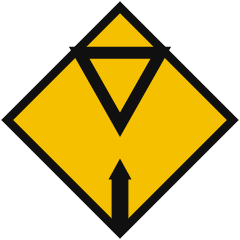
19. What will the driver have to do at the point this sign refers to?
Show answer
Answer C: Slow down and let conflicting traffic go first, stopping if that is what it takes
Further along, the driver has to let conflicting traffic and pedestrians go first, reducing speed and stopping whenever that is necessary to avoid interfering with them.
-
20. You arrive at an intersection with no signs, no signals and no markings at the same time as a vehicle on the road to your right. What must you do?
Show answer
Answer B: Yield to the vehicle on your right
At an uncontrolled intersection you must yield to a vehicle already in the intersection or approaching from your right.
-
21. You are hosting a party and a guest who has been drinking wants to drive home. What should you do?
Show answer
Answer D: Stop serving and arrange a ride or a bed
Only time removes alcohol, so a host who wants to prevent a crash has to remove the driving, not try to speed up sobering that cannot be sped up.
-
22. A pedestrian starts to cross against a Do Not Walk signal, right in front of you. What should you do?
Show answer
Answer D: Slow or stop and let the person reach safety
Even when a pedestrian is crossing unlawfully, a driver must take reasonable care to avoid hitting that person.
-
23. At 45 mph you look at a navigation screen for four seconds. Roughly how far do you travel unseeing?
Show answer
Answer D: About 260 feet
At 45 mph you cover roughly 66 feet a second, so four seconds on a screen is around 260 feet of road that you never looked at.
-
24. How many points does Maryland assess for exceeding the posted speed limit by 10 miles per hour or more?
Show answer
Answer A: 2 points
Maryland assesses 2 points for speeding by 10 mph or more, the same total it uses for following another vehicle too closely.
-
25. You find that the road surface has turned to sheet ice. What speed is appropriate?
Show answer
Answer A: A crawl, slow enough that you could stop without braking hard
Ice can cut grip to a fraction of normal, so stopping takes many times the usual distance and only a crawl leaves any margin.