
Maryland MVA Motorcycle Practice Test 3
- Questions25
- Correct to pass21
- Passing score84%
- Minimum age15 years 9 months
-
1. A parking space is marked with the international symbol of access. Who may use it?
Show answer
Answer A: Only a vehicle displaying the required placard or plate
Accessible spaces may be used only by a vehicle that displays a valid disability placard or plate, no matter how short the stop would be.
-
2. A pedestrian near the curb is staring at a phone and not looking at traffic. What should you do?
Show answer
Answer A: Slow down and be ready to stop, because the pedestrian may step out without looking
Distracted pedestrians step into the street without checking. Assume they have not seen you and give yourself time and space to stop.
-
3. What fines does Maryland set for handheld telephone violations?
Show answer
Answer A: Up to 75 dollars for a first offense, 125 for a second and 175 for a third or later
Maryland sets escalating maximum fines of 75, 125 and 175 dollars, and points are not assessed unless the offense contributes to a collision.
-
4. What is the function of a regulatory sign?
Show answer
Answer A: To inform road users of traffic laws or regulations that apply at that location
Regulatory signs state requirements that carry the force of law where they are posted, so disregarding one is a violation rather than a lapse of judgment.
-
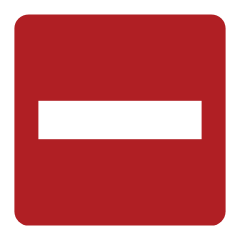
5. At which location is this sign normally installed?
Show answer
Answer D: Facing traffic that could turn into a one-way roadway or ramp against the flow
It is posted where a driver could otherwise enter a ramp or a one-way roadway from the wrong end, so it faces exactly the traffic that has to be kept out.
-
6. You have stopped at a stop sign, but a parked truck blocks your view along the cross street. What should you do?
Show answer
Answer A: Creep forward slowly and stop again where you can see
When something blocks the view, a second stop closer to the intersection is the only safe way to see, and it must come before your vehicle enters the traffic lane.
-
7. You are stopped at a red light waiting to turn right where the turn is allowed. Besides traffic from the left, what must you check?
Show answer
Answer D: Both crosswalks, and anyone approaching along your right side
A right turn on red crosses the crosswalk in front of you and enters the one on the cross street, and cyclists often approach along your right.
-
8. You are behind a slow vehicle on a two-lane road and a marked passing lane begins a mile ahead. What is the sensible choice?
Show answer
Answer D: Wait for the passing lane rather than using the opposing lane
A passing lane lets you overtake without ever entering the lane used by oncoming traffic, which is far safer than a pass a minute earlier.
-
9. You reach a T intersection where the cross street has a ONE WAY sign pointing to the right. What may you do?
Show answer
Answer B: Turn right only, because the street carries traffic in that direction
The arrow shows the only direction traffic may travel, so the only legal movement from the terminating road is a right turn.
-
10. A bicycle symbol topped by two chevrons is painted in the middle of a travel lane. What does that marking indicate?
Show answer
Answer D: Bicyclists share the lane with motor vehicles and may ride away from the curb
A shared lane marking shows drivers where bicyclists are likely to ride in a lane used by both bicycles and motor vehicles.
-
11. Every signal head at an intersection is flashing red in all directions. How should you treat the intersection?
Show answer
Answer C: As an all-way stop, stopping and then going in turn
Red flashing in every direction means each approach must stop, so the intersection works exactly like an all-way stop.
-
12. Where is the no passing zone pennant sign installed?
Show answer
Answer A: On the left side of the roadway
The pennant is placed on the left side of the roadway at the beginning of the no-passing zone, in the field of view of a driver who is thinking about overtaking.
-
13. What is the most common cause of rear-end collisions?
Show answer
Answer C: Following too closely to stop in time
A driver who leaves too little space has no room to perceive, react and brake when the vehicle ahead slows, which is why space management prevents rear-end crashes.
-
14. You reach a stop-controlled intersection at the same time as a driver on your left, but that driver is already moving through the crossing. Who goes first?
Show answer
Answer C: The driver who is already inside the intersection
A vehicle already in the intersection has the right of way, and the rule about yielding to the right applies only before anyone has entered.
-
15. An overhead sign shows that the right lane is EXIT ONLY. What does that mean if you intend to stay on the highway?
Show answer
Answer B: You have to move out of that lane before the exit
An exit only lane leaves the highway completely, so a driver continuing on the highway has to change lanes before it does.
-
16. How should cargo be carried on a motorcycle?
Show answer
Answer D: Kept low, in saddlebags or at about seat level
Keeping the load low preserves the center of gravity and the normal handling of the motorcycle, while a high load makes it top heavy and unstable.
-
17. Roughly how far does a vehicle travel at 55 mph during the few seconds a driver spends reading a text message?
Show answer
Answer D: About the length of a football field
Sending or reading a message takes the eyes off the road for about five seconds, which at 55 mph covers roughly the length of a football field with nobody watching the road.
-
18. You face a red light at an intersection that has no stop line and no marked crosswalk. Where must you stop?
Show answer
Answer C: Before entering the intersection
With no line and no crosswalk, the stopping point is the near edge of the intersecting roadway, close enough to see cross traffic but clear of it.
-
19. Where must the engine cut-off switch be set before the starter button will crank the engine?
Show answer
Answer A: In the run position
The cut-off switch sits in the ignition circuit, so the engine will not start or run while it is set to off.
-
20. On a narrow two-lane road a line of vehicles has built up behind you. What is the safe and courteous action?
Show answer
Answer D: Pull into a turnout or a safe wide spot and let them go by
A slow vehicle holding up a queue invites risky passing; using a turnout clears the road without anyone having to take a chance.
-
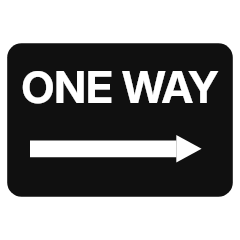
21. A driver disregards this sign and turns so as to travel against the direction it establishes. What is the immediate danger?
Show answer
Answer D: The driver will face traffic head on, because every lane comes the other way
Turning against the established direction puts the vehicle nose to nose with all the traffic on that street, which is why the mistake has to be corrected at once.
-
22. Red pavement markings are used on a roadway to show that
Show answer
Answer A: it must not be entered from that direction
Red markings identify a roadway that is not to be entered or used, and they also mark the pavement of truck escape ramps.
-
23. Why can a motorcycle ahead of you slow down without any warning light showing?
Show answer
Answer B: The rider may slow by downshifting or rolling off
Riders often lose speed by closing the throttle or changing down, which does not switch on the brake light, so watch the machine itself and keep back.
-
24. You are driving on an open highway in a strong crosswind. What is the safest adjustment?
Show answer
Answer A: Reduce speed and keep a firm grip, expecting gusts on bridges and beside large vehicles
Gusts hit hardest in open gaps, on bridges and when passing high-sided vehicles, so a lower speed and a firm grip let you correct before you are pushed out of your lane.
-
25. What phone use does Maryland allow a driver who is under 18?
Show answer
Answer D: None, because the ban covers hands free devices as well as handheld ones
Maryland bars a driver under 18 from using a wireless communication device, handheld or hands free, while operating a motor vehicle, with an exception for contacting a 9-1-1 system.