
Maryland MVA Motorcycle Practice Test 29
- Questions25
- Correct to pass21
- Passing score84%
- Minimum age15 years 9 months
-
1. What are the maximum penalties for a first Maryland conviction for driving while impaired by alcohol?
Show answer
Answer A: Up to 2 months in jail or a fine of up to 500 dollars, or both
Maryland treats driving while impaired as the lesser offense, capping a first conviction at two months of imprisonment or a 500 dollar fine or both.
-
2. As a center two-way left-turn lane reaches an intersection, the markings change into a single left-turn lane. What does that mean for you?
Show answer
Answer D: From that point it serves one direction only, so use it just to turn left
Where the shared lane becomes a marked turn bay it belongs to one direction of travel, and only vehicles making that left turn may occupy it.
-
3. You need to leave the road and pull onto the shoulder. What should you check first?
Show answer
Answer A: Whether the shoulder surface is firm enough to support the motorcycle
Soft or loose shoulder material can grab the wheels or let the side stand sink, so confirm the surface is firm, signal, and then pull well clear of traffic.
-
4. A freeway sign shows a minimum speed limit. What does it require?
Show answer
Answer B: That you keep up with it unless conditions make that unsafe
A minimum speed limit keeps very slow vehicles off the highway, but weather, traffic or a mechanical problem may make a lower speed necessary and lawful.
-
5. How should a helmet sit on the head once it is fastened?
Show answer
Answer C: Level on the head, with the eye port giving a clear view of the road
A helmet worn level protects the forehead and gives full vision, while one pushed back leaves the forehead exposed in a crash.
-
6. You want to turn left across the oncoming lane into a shopping center driveway. Who must you yield to?
Show answer
Answer B: Oncoming traffic and anyone using the sidewalk
A left turn into a driveway crosses both the oncoming lane and the sidewalk, so you give way to traffic and to pedestrians before completing it.
-
7. Why are sign shapes and colors standardized across the whole country?
Show answer
Answer D: So a driver knows the kind of message before reading it
Uniform shapes and colors let a driver classify a sign as regulatory, warning or guide from a distance, before the legend can be read.
-
8. What kind of sole and heel suit motorcycle boots?
Show answer
Answer A: A hard, slip resistant sole with a low heel that will not catch
Boots have to grip the pavement when you put a foot down and grip the footrests while you ride, and a tall heel can catch on the ground or on the machine.
-
9. You are the first driver on a road just after a storm. What should you plan for?
Show answer
Answer B: Branches, mud and other debris hidden around the next bend
Storm debris lands where nobody has cleared it yet, often just beyond a curve or a crest, so reduce speed and look much further ahead.
-
10. What does the last step of T-CLOCS, Stands, ask a rider to check?
Show answer
Answer D: That the stands are not bent and that their springs hold them up
A bent stand or a weak spring can let the stand fall while riding, so both the sidestand and the centerstand are checked for damage and spring tension.
-
11. A pedestrian steps off the curb without looking your way. What should you assume?
Show answer
Answer B: That the person has not seen you at all, and be ready to stop for them
Defensive driving means assuming you have not been seen until there is clear evidence that you have.
-
12. You have finished a distracting task and your eyes are back on the road. What is true?
Show answer
Answer A: Your full attention takes a while to come back
Studies of drivers show attention lags behind the eyes for many seconds after a phone or a screen task, so the danger continues after the task is over.
-
13. What is the maximum civil penalty for a Maryland school zone speed camera citation alleging 12 to 15 miles per hour over the limit?
Show answer
Answer D: 40 dollars
Maryland caps the school zone speed monitoring penalty at 40 dollars in the lowest band, rising to 70 and then 120 dollars in the higher bands.
-
14. You are approaching a highway-rail grade crossing marked only with a crossbuck sign. What does that sign require?
Show answer
Answer A: Yield to any approaching train and cross only when the tracks are clear
The crossbuck is a regulatory yield sign, and a train can never stop or steer around a vehicle, so the driver must always give way.
-
15. A rider chooses an open face helmet. What does that choice make necessary?
Show answer
Answer A: Separate goggles or a face shield, because the face is uncovered
An open face helmet gives no eye or face protection, so the rider must add goggles or a face shield that will not shatter and that seals against the wind.
-
16. In normal operation, which indication always comes between a green and a red on the same signal face?
Show answer
Answer C: A steady yellow
The yellow change interval must follow every green or green arrow, so a signal can never jump straight from green to red.
-
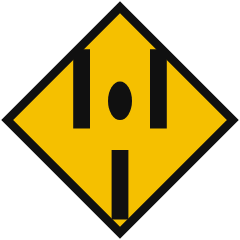
17. What must a driver be ready for beyond this sign?
Show answer
Answer C: Vehicles approaching from the opposite direction in the next lane over
The separation between the two directions runs out, so from that point oncoming vehicles share the same pavement and the driver has to keep right.
-
18. Which of these is a known cause of a high speed wobble?
Show answer
Answer C: Incorrect tire pressure or a load carried too far back and too high
Wobble is usually traced to tires, wheels, loading or poorly mounted accessories such as a windshield or fairing, so check pressures and how the machine is loaded.
-
19. You stop behind another vehicle at a traffic light. How much space should you leave?
Show answer
Answer D: Enough to see where its rear tires touch the pavement
Seeing the rear tires on the road leaves room to steer around the vehicle if it stalls, and gives a cushion if you are struck from behind.
-
20. At night you are waiting to turn left and can see only the headlights of an approaching vehicle. Why should you allow a bigger margin?
Show answer
Answer D: Because lights alone make speed and distance hard to judge
With no other visual cues, two points of light give you very little information about how fast the vehicle is closing, so leave extra margin.
-
21. What is the main advantage of a face shield over goggles?
Show answer
Answer D: It protects the whole face, not only the eyes
Goggles keep wind and debris out of the eyes, but a shatter resistant face shield also protects the rest of the face in a crash.
-
22. A police officer in the intersection raises a hand toward you although your signal is green. What should you do?
Show answer
Answer B: Stop and wait for the officer to wave you on
An officer directing traffic overrides signals and signs, and drivers must follow the officer even when the light says otherwise.
-
23. What is the right speed for a normal right turn at a city corner?
Show answer
Answer C: Slow enough to hold your lane and stop for a pedestrian
A city right turn is tight and crosses a crosswalk, so the correct speed is one that keeps you inside your lane and still allows a stop.
-
24. You are approaching a refuse collection truck working along your street. What should you expect?
Show answer
Answer D: Workers stepping into the road around the truck
Collection crews move constantly between the truck and the curb, often from where you cannot see them, so slow right down and pass only when the whole area is clear.
-
25. Traffic is heavy and crawling where a sign warns that your lane ends and two lanes must become one. What is the best practice?
Show answer
Answer C: Use the lane to the end, then take turns merging one by one
In stop-and-go traffic the zipper merge, using both lanes up to the merge point and then alternating, keeps the queue shorter and traffic moving; in free-flowing traffic move over as soon as it is safe.