
Maryland MVA Motorcycle Practice Test 14
- Questions25
- Correct to pass21
- Passing score84%
- Minimum age15 years 9 months
-
1. Oil is visible running down the front fork tubes. What does that mean?
Show answer
Answer C: A fork seal has failed and the suspension needs repair
Fork oil escaping past a seal means the front suspension is losing its damping, and the oil can also reach the front brake and ruin its grip.
-
2. A wide solid white line separates the through lanes from an exit lane. What does it tell drivers?
Show answer
Answer B: The choice of lane should already have been made
A channelizing line marks where the paths separate and crossing it is discouraged or prohibited, so the lane change has to happen upstream.
-
3. What is the main reason a rider should keep a generous following distance on a rough, broken road?
Show answer
Answer B: So the rider can see and plan for holes and broken pavement in time to react
The vehicle ahead hides the pavement, so extra space gives you time to spot a hole or a broken edge and to choose a path around it.
-
4. What is the correct way to secure a load on a motorcycle?
Show answer
Answer C: Fasten it with elastic cords using several attachment points and check it at every stop
Several attachment points hold the load tight so it cannot shift or fall into the wheel or the chain, and checking at stops catches a load that has worked loose.
-
5. You signaled a lane change and the signal did not switch itself off afterwards. Why does that matter?
Show answer
Answer B: Other drivers may act on a turn you do not intend to make
A signal left on tells other drivers you are about to turn, and someone may pull out in front of you. Cancel it as soon as the maneuver is finished.
-
6. A pedestrian is crossing at a corner where no crosswalk is painted on the pavement. What is your duty?
Show answer
Answer A: Yield, because a legal crosswalk exists at the corner even without paint
Every intersection has a crosswalk whether or not it is marked, and drivers must yield to pedestrians crossing there.
-
7. Which is an early warning that fatigue is affecting your riding?
Show answer
Answer D: You miss turns and signs and have to think about routine actions
Fatigue shows up first as slower thinking and missed information, so treat lapses in attention as a signal to stop and rest.
-
8. How does braking distance change if you double your speed?
Show answer
Answer D: It grows much more than twice as long
Braking distance increases with the square of speed, so doubling speed roughly quadruples the distance needed to stop.
-
9. A yellow diamond showing a bicycle is posted on a rural road. What should a driver expect?
Show answer
Answer A: Bicyclists crossing or riding along the roadway there
The bicycle warning sign is used where a bikeway crosses the road or where riders are likely to be in the traffic lanes, so drivers should look carefully and pass wide.
-
10. How often should a rider change position within the lane?
Show answer
Answer C: As often as the traffic, the road surface and the hazards around you change
Lane position is a tool for keeping space and visibility, and both of those change constantly as traffic and road conditions change.
-
11. You approach a one-lane bridge and there is a yield sign facing your side of it. What does that mean?
Show answer
Answer B: Oncoming traffic crosses the bridge first and you wait at the approach
At a one-lane bridge the yield sign tells one direction to give way, so you wait clear of the bridge until oncoming traffic has crossed.
-
12. A deer crosses the road in front of you and disappears into the trees. What should you expect?
Show answer
Answer B: That other deer are likely to follow it across the very same stretch of road
Deer usually move in groups, so one crossing the road is a warning that more may follow.
-
13. You are circulating in a roundabout and a vehicle is waiting to enter ahead of you. What should you do?
Show answer
Answer D: Keep going, because circulating traffic does not stop for entering vehicles
Stopping in the circle to be polite surprises the drivers behind you and defeats the design; entering traffic is the side that waits.
-
14. You are approaching a multilane roundabout. When should you choose your lane?
Show answer
Answer C: Before you enter, using the lane-choice sign on the approach
You select your lane on the approach the way you would at any multilane intersection, then stay in that lane all the way around, because changing lanes inside a roundabout creates side-impact conflicts.
-
15. You are turning right where a paved trail crosses the road just past the corner. What should you look for?
Show answer
Answer B: Cyclists and walkers arriving from either direction on the trail
A shared use path carries two-way traffic on foot and on bicycles, so scan both directions along the trail before crossing it.
-
16. You are in the middle lane of a one-way street with three lanes when a police car approaches from behind with lights and siren. What should you do?
Show answer
Answer C: Pull to the nearest curb and stop clear of the lanes
On a one-way street you clear to whichever curb is closest, so the emergency vehicle gets a clear path down the open lanes.
-
17. What should motorcycle footwear provide?
Show answer
Answer B: Sturdy support above the ankle with hard, slip resistant soles
Boots that cover the ankle support and protect it, while hard slip resistant soles keep the rider steady at stops, and laces should be tucked in so they cannot catch.
-
18. A friend wants a ride, but their feet do not reach the passenger footrests. What should you do?
Show answer
Answer A: Do not carry them, since they cannot hold a stable position
A passenger who cannot plant both feet on the footrests cannot brace or stay in place, and dangling legs can reach the chain, the exhaust or the wheel.
-
19. A bus stopped at the corner hides the crosswalk you are about to turn across. What should you do?
Show answer
Answer C: Turn slowly, ready to stop for anyone stepping out in front of it
People often step into the road from in front of a stopped bus, so approach the hidden crosswalk slowly and be ready to stop.
-
20. Which clothing offers the best protection for a rider?
Show answer
Answer D: Leather or sturdy synthetic gear covering the arms and legs completely
Leather and purpose built synthetics resist abrasion far better than ordinary clothing, and full coverage also guards against sun, wind chill and flying debris.
-
21. What has to be done with the helmet chin strap on every ride?
Show answer
Answer B: Fastened snugly, because an unfastened helmet comes off in a crash
A helmet only protects while it stays on the head, and an unfastened or loose strap lets it leave the head in the first moments of a crash.
-
22. Why does a rider on an unfaired motorcycle tire faster on a long highway ride than a driver would?
Show answer
Answer A: Constant wind pressure and noise drain energy hour after hour
Fighting wind pressure and enduring wind noise for hours is physically tiring, which is why wind protection and regular breaks matter on long rides.
-
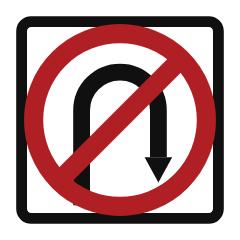
23. Why is this restriction used so often on a divided road just before a crest or a bend?
Show answer
Answer A: Because a vehicle turning across the median there stays hidden from approaching drivers until it is too late
The maneuver needs a long gap and good visibility, and where sight distance is short an approaching driver has no time to react to a vehicle turning across the road.
-
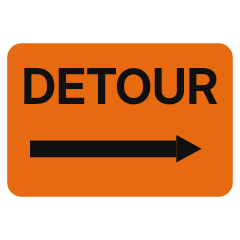
24. Once a driver has joined the route this sign begins, how is the rest of the way marked?
Show answer
Answer B: By further markers of the same kind at each turn, until the original road is rejoined
The alternate route is signed continuously, with a marker at every turn, so a driver with no local knowledge can follow it back to the original road.
-
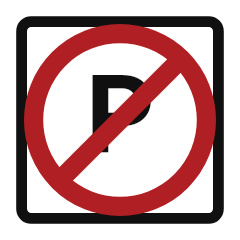
25. A driver leaves the vehicle at the curb where this sign is posted and walks away for two minutes. Is that allowed?
Show answer
Answer B: No, leaving the vehicle unattended there is prohibited whatever the length of the absence
Walking away leaves the vehicle parked, and the prohibition holds regardless of how long the driver is gone or whether the engine is left running.