
Maryland MVA Permit Practice Test 4
- Questions25
- Correct to pass22
- Passing score88%
- Minimum age15 years 9 months
-
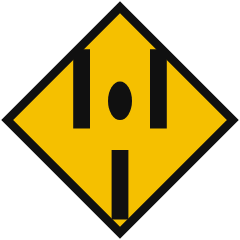
1. What should a driver do first after passing this sign?
Show answer
Answer A: Move into the right-hand lane and stay there
Traffic returns to two-way operation, so the driver keeps to the right of the centerline and stops treating the left side as available.
-
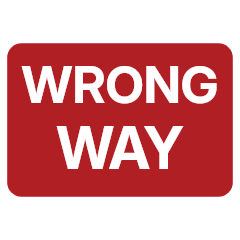
2. At a freeway exit ramp, this sign normally backs up which other regulatory sign posted nearer to the ramp terminal?
Show answer
Answer D: The sign that forbids entering that roadway at all
The two work as a pair at ramp terminals: one keeps drivers from turning in, and this one sits farther along to catch a driver who has already entered.
-
3. What fines does Maryland set for handheld telephone violations?
Show answer
Answer A: Up to 75 dollars for a first offense, 125 for a second and 175 for a third or later
Maryland sets escalating maximum fines of 75, 125 and 175 dollars, and points are not assessed unless the offense contributes to a collision.
-
4. The signal turns green as you approach an intersection. What is the safest practice?
Show answer
Answer B: Look left, then right, then left again, and make sure the intersection is clear before entering
A green light gives permission but does not guarantee the intersection is empty, and a quick scan catches a vehicle running the red or a pedestrian still crossing.
-
5. You park a manual transmission car facing uphill at a curb. What is the correct combination?
Show answer
Answer A: First gear, wheels turned away from the curb, parking brake set
Facing uphill the car would roll back, so first gear resists that, the wheels turned out let a tire catch the curb, and the parking brake holds it.
-
6. In most states, how far before a turn must your signal already be on in city traffic?
Show answer
Answer B: At least 100 feet, roughly the length of six or seven cars
Most states require the signal for at least 100 feet before a turn in city driving, which gives drivers behind you time to react before you slow; several require more at higher speeds.
-
7. You are about to slow down sharply for a turn. Which check comes first?
Show answer
Answer A: A look in the mirror to see how close the traffic behind you is
Any hard slowing needs a mirror check first, because the driver behind is the one who has to react to it.
-
8. You are waiting inside the intersection to turn left when your light turns red. What should you do?
Show answer
Answer A: Complete the turn as soon as the way is clear
Once you have legally entered the intersection you should clear it as soon as the oncoming traffic has stopped, rather than sit in the path of cross traffic.
-
9. What is true about an airbag once it has inflated in a crash?
Show answer
Answer B: It must be replaced by a technician before the car is driven any further
An airbag is a single use device, and the module and often the belts must be replaced before the vehicle protects anyone again.
-
10. On a highway with mileage-based exit numbering, you have just passed exit 42 and are looking for exit 55. About how far is it?
Show answer
Answer B: Thirteen miles
With mileage-based numbering each exit takes the number of the nearest milepost, so subtracting one exit number from another gives the distance in miles.
-
11. A driver ahead of you extends the left arm straight out horizontally through the window. What is being signaled?
Show answer
Answer C: A left turn
The left arm held straight out is the standard hand signal for a left turn.
-
12. You have started to pass and you see the no-passing zone beginning ahead. What should you do?
Show answer
Answer D: Ease off, drop back and return to your own lane
A pass must be completed before the no-passing zone starts. If it will not fit, abandon it and slot back in behind.
-
13. Is it acceptable to watch a video on a screen positioned where you can see it while driving?
Show answer
Answer B: No, the screen pulls your eyes and attention away from the road
Moving pictures are among the strongest visual distractions. Video screens must be out of the driver's view while the vehicle is moving.
-
14. You have finished a distracting task and your eyes are back on the road. What is true?
Show answer
Answer A: Your full attention takes a while to come back
Studies of drivers show attention lags behind the eyes for many seconds after a phone or a screen task, so the danger continues after the task is over.
-
15. You are passing a line of slow traffic in the lane beside you and you notice a gap in that line ahead. What should you expect?
Show answer
Answer A: A vehicle may pull out of that gap into your lane
A gap in a slow line is an invitation to any driver waiting to turn out of a side street or to change lanes, and they are looking at the gap rather than at you.
-
16. After completing a turn you notice your signal is still flashing. What should you do?
Show answer
Answer A: Switch it off at once, before other drivers act on it
A signal left on after a turn is a false message, and drivers waiting to pull out may move into your path because of it.
-
17. How do extra passengers affect a driver, especially a new one?
Show answer
Answer A: They increase the chance of distraction and of crashes
Conversation, laughter and horseplay pull a driver's attention away from the road. Crash risk for young drivers rises with each additional passenger.
-
18. You reach an intersection showing a steady red light, and a stop line is painted across your lane. Where must you bring the vehicle to a complete stop?
Show answer
Answer C: Before the stop line
A steady red requires a complete stop before the marked stop line. Where there is no stop line you stop before the crosswalk, and where there is neither, before entering the intersection.
-
19. The signal ahead has a sign prohibiting left turns, and your route needs a left. What should you do?
Show answer
Answer D: Go straight on and find a legal place to turn and come back
A turn prohibition applies to every driver, so you continue through and reach your route by another legal turn.
-
20. What does a posted speed limit sign represent?
Show answer
Answer B: The maximum speed permitted under ideal conditions
A speed limit is an upper limit that assumes good weather, good visibility and light traffic, so the safe speed is often lower than the posted figure.
-
21. A set of reversible express lanes is closed off with gates and signs while it runs the other way. What must you never do?
Show answer
Answer C: Enter past a closed gate or a sign showing the lanes are closed
When reversible lanes are closed they may already be carrying traffic in the opposite direction, so entering past a gate can put you head-on into that traffic.
-
22. After a Maryland officer serves an order of suspension for a refusal or a 0.08 result, how long may a licensed driver keep driving, and how long is there to request a hearing?
Show answer
Answer B: 45 days of driving, with a hearing request due within 10 days
Maryland issues a temporary license good for 45 days for a licensed driver, and allows a hearing to be requested at the stop or within 10 days.
-
23. Your passengers are being noisy and you are losing concentration. What should you do?
Show answer
Answer B: Ask them to settle down, or pull over safely until they do
The driver is responsible for the conditions inside the vehicle, and stopping is always better than driving distracted.
-
24. What is the minimum light transmittance Maryland allows through window tinting added after manufacture?
Show answer
Answer C: 35 percent
Maryland requires aftermarket tinting on a registered passenger vehicle to allow light transmittance of at least 35 percent through the window.
-
25. On a regulatory sign, what does a red circle with a diagonal slash drawn over a symbol mean?
Show answer
Answer D: The movement or action shown by the symbol is prohibited
A red circle with a diagonal slash is the standard way of showing that the movement pictured inside it, such as a U-turn or a right turn, is not allowed.