
Maryland MVA Permit Practice Test 36
- Questions25
- Correct to pass22
- Passing score88%
- Minimum age15 years 9 months
-
1. You cannot avoid a wide puddle that covers only the right half of your lane. What should you expect?
Show answer
Answer D: The water can tug the vehicle toward that side, so slow before it and grip the wheel
Water dragging on the tires of one side only pulls the vehicle that way. Reduce speed before you reach it and hold the wheel firmly.
-
2. A warning sign showing two children on a see-saw is posted beside a residential street. What does it mean?
Show answer
Answer D: A play area lies beside the road and children may run out
The playground sign warns that children are present next to the roadway and may enter it without looking, so drivers should cover the brake and slow down.
-
3. How long can cannabis affect a driver?
Show answer
Answer A: For hours after the strongest effects have passed
Slowed reactions, poor tracking and weak judgment of distance can last for hours, well beyond the point where the user believes the effects are over.
-
4. On loose gravel or deep fresh snow, how does an antilock system affect the stopping distance?
Show answer
Answer D: It can lengthen it, although you keep the ability to steer
On loose surfaces a locked wheel piles up a wedge of gravel or snow that helps it stop, so the antilock stop can be longer even though steering still works.
-
5. You notice a bulge on the sidewall of one of your tires. What should you do?
Show answer
Answer D: Have the tire replaced before driving far, because it could blow out
A sidewall bulge means the internal cords have broken and only the rubber is holding the air. The tire can fail suddenly at any speed.
-
6. While you wait for the ambulance at a crash, what is the most useful help you can give?
Show answer
Answer C: Keep the person still and warm, and press down firmly on any heavy bleeding
Keeping an injured person still and warm and controlling bleeding are among the few things a bystander can safely do.
-
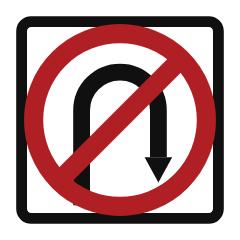
7. A driver who wants to reverse direction arrives at this sign. What is allowed?
Show answer
Answer C: Going on and reversing direction only where the maneuver is permitted
The restriction removes that maneuver at that spot entirely, so the driver has to continue and turn the vehicle around at a place where it is not prohibited.
-
8. The steering suddenly becomes very heavy while you are driving. What has happened and what should you do?
Show answer
Answer C: The power steering has failed, so steer with more effort and pull over
Loss of power assistance leaves the steering usable but very heavy. Keep both hands on the wheel, slow gradually and pull off the road to check it.
-
9. The school bus stop ahead sign is installed where
Show answer
Answer C: a school bus stop cannot be seen from far enough away by approaching drivers
This school warning sign is used in advance of a bus stop that lacks adequate sight distance and cannot be relocated, so drivers are warned before the stopped bus comes into view.
-
10. The light turns yellow when your front wheels are already past the stop line inside the intersection. What should you do?
Show answer
Answer B: Keep going and clear the intersection without speeding up
Once you are legally in the intersection the safest and correct action is to continue through and clear it, without accelerating.
-
11. If you must abandon a vehicle stuck on the tracks with a train coming, why do you move toward the train and away at an angle?
Show answer
Answer D: Because debris from the impact is thrown forward, away from the train
A train pushes wreckage down the track ahead of it, so walking toward the train and off to the side keeps you out of the debris path.
-
12. A driver reaching a stop sign is required to do what?
Show answer
Answer D: Come to a complete stop and then proceed only when it is safe
A stop sign requires a full stop before the stop line, crosswalk or intersection, after which the driver may go on once the way is clear.
-
13. A driver ahead brakes for no reason you can see, again and again. What should you do?
Show answer
Answer B: Increase your following distance and be ready for yet another stop
Unexplained braking tells you the driver is unsure or distracted, so the safe answer is more room, not less.
-
14. A black on white regulatory sign at an intersection reads NO TURNS. What may a driver do there?
Show answer
Answer B: Only continue straight through the intersection
The NO TURNS sign bans turns in every direction at that intersection, so the only lawful movement from that approach is straight through.
-
15. How does a NO OUTLET sign differ from a DEAD END sign?
Show answer
Answer B: It warns that a whole group of streets has no way out
No Outlet is posted where the road leads into a network of streets from which there is no through route, while Dead End refers to the single street itself.
-
16. Which of these is an early warning that you are too tired to keep driving?
Show answer
Answer C: Not remembering the last few miles you drove
Memory gaps, repeated yawning, heavy eyelids and drifting are the body signaling that sleep is winning, and they mean stop rather than push on.
-
17. Travelling at about 55 mph on dry pavement, roughly how much room does an average car need to perceive, react and stop?
Show answer
Answer D: About 300 feet, close to the length of a football field
Reaction distance plus braking distance at 55 mph comes to roughly 300 feet on good dry pavement, and considerably more on a wet or loose surface.
-
18. A delivery truck is parked in your lane and you must use the oncoming lane to get around it. Who has the right of way?
Show answer
Answer D: The oncoming traffic, because their lane is clear
The driver whose own lane is obstructed waits, because using the other lane is a favor from oncoming traffic, not a right.
-
19. You are clear of the tracks after your vehicle stalled on a crossing. Whom should you contact?
Show answer
Answer C: The emergency number posted on the blue sign at the crossing, or 911
Grade crossings carry an emergency notification sign with a railroad phone number and a crossing identification number so that approaching trains can be stopped, and 911 works if that sign is not visible.
-
20. Why should you not leave the engine running when you walk away from your vehicle?
Show answer
Answer C: Because the vehicle can be stolen or can move on its own
An unattended running vehicle is an easy theft and, if the transmission slips or is knocked out of park, it can roll away with nobody at the wheel.
-
21. Where do you find how much weight your vehicle may carry?
Show answer
Answer C: On the placard in the driver door opening
The certification placard in the driver door opening gives the load limit and the recommended cold tire pressures for the vehicle as built.
-
22. You want to stop briefly and the only space is in the travel lane alongside a vehicle already parked at the curb. Is this allowed?
Show answer
Answer D: No, double parking blocks a travel lane and is prohibited
Stopping in the roadway beside a parked vehicle removes a lane from traffic and forces other drivers to swerve around you, which is why double parking is prohibited.
-
23. Traffic in your lane is backed up and the paved shoulder looks clear. May you drive along it to get past?
Show answer
Answer C: No, the shoulder is not a travel lane
Passing must be done within the roadway; driving on the shoulder to get around traffic is prohibited and surprises anyone entering from the right.
-
24. Which of these does NOT affect how fast alcohol reaches the bloodstream?
Show answer
Answer A: How confident the drinker feels
Food, the strength of the drinks and the speed of drinking all change how fast alcohol is absorbed, but a drinker's confidence changes nothing at all.
-
25. You have a steady green ball to turn left, and the oncoming traffic gets a green left arrow. What does that mean for you?
Show answer
Answer C: Oncoming vehicles will turn across your path, so you must wait
A green ball is permissive, so when the oncoming side receives a protected arrow those vehicles have priority and you must yield until they clear.