
Maryland MVA Permit Practice Test 33
- Questions25
- Correct to pass22
- Passing score88%
- Minimum age15 years 9 months
-
1. You are stopped in slow traffic and a motorcycle comes up between the lanes. What should you do?
Show answer
Answer D: Hold your position and avoid any sudden lane change
The danger to a rider between lanes comes from a vehicle moving sideways without warning, so staying predictable is what protects them.
-
2. What mandatory minimum does Maryland impose on a second conviction for driving under the influence within 5 years of a prior one?
Show answer
Answer B: Imprisonment of at least 5 days, which cannot be suspended
Maryland requires a minimum of 5 days of imprisonment for a second conviction within 5 years and 10 days for a third or later one, and neither minimum may be suspended.
-
3. A traffic signal ahead is showing a flashing red light. What does it require?
Show answer
Answer C: Stop completely, then go when the way is clear, as at a stop sign
A flashing red light has the same meaning as a stop sign: stop completely, yield to traffic and pedestrians, then proceed when it is safe.
-
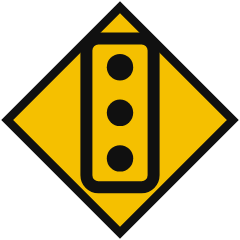
4. What does this sign require of the driver?
Show answer
Answer D: Reducing speed and being ready to stop at the intersection ahead
The advance notice asks the driver to slow and be ready to stop, while whether a stop is actually needed depends on the indication displayed on arrival.
-
5. A school bus ahead of you has its red lights flashing and its stop arm extended. What are you required to do?
Show answer
Answer A: Stop and stay stopped until the lights stop flashing and the bus starts moving
Flashing red lights and an extended stop arm mean children are getting on or off, so traffic must stop and wait until the bus withdraws the signals and moves again.
-
6. You have loaded the trunk heavily. Why might oncoming drivers flash their lights at you at night?
Show answer
Answer D: The rear sits lower, so your headlights point higher and dazzle them
Weight in the back tips the vehicle nose up and lifts the beam pattern, so low beams shine into the eyes of drivers coming the other way.
-
7. How should you handle a prescription or over the counter medicine before driving?
Show answer
Answer D: Read the label and ask a pharmacist or doctor whether it affects driving
Many common medicines, including allergy and cold remedies, cause drowsiness or slowed reactions, and the label or a pharmacist can tell you whether driving is safe.
-
8. You are already inside a roundabout when an emergency vehicle approaches with lights and siren. What should you do?
Show answer
Answer B: Continue to your exit, leave the roundabout, then pull over and stop
Stopping inside a roundabout blocks the circulating roadway, so you should exit first and then pull over clear of the intersection.
-
9. You are passing a crash on the other side of a divided highway. What should you do?
Show answer
Answer D: Keep your eyes on your own lane and the traffic around you
Staring at a crash scene, often called rubbernecking, causes sudden slowing and secondary collisions. Your attention belongs on the traffic in front of you.
-
10. About how far ahead do low beam headlights let you see on a dark road?
Show answer
Answer B: About 250 feet
Low beams light roughly 250 feet of road, and high beams roughly 350 to 500 feet, which sets the limit on a safe night speed.
-
11. Where are children in the greatest danger around a school bus?
Show answer
Answer B: In the roadway right around the bus, especially in front
The danger zone is the band of roadway around the bus where the driver's view is poorest, and children crossing in front of the bus are hardest to see.
-
12. You are waiting to turn left and an oncoming vehicle stopped in the near lane to turn left blocks your view of the far lane. What should you do?
Show answer
Answer A: Wait where you are until you can see that the far lane is completely clear
The lane you cannot see is where the crash comes from, so you hold your position until the view opens up.
-
13. A turn restriction sign at the corner shows a range of times below the symbol. What does that mean?
Show answer
Answer A: The turn is banned only during the hours shown on the sign
Times posted under a regulatory symbol set the period during which the restriction applies; outside those hours the movement is permitted.
-
14. You are approaching the crest of a hill and cannot see the road beyond it. What should you do?
Show answer
Answer C: Slow down and keep well to the right
Beyond a blind crest there may be a stopped vehicle, a cyclist or an oncoming driver crossing the center line, so reduce speed and hold your own side.
-
15. On a street with parking along the curb, the shared lane marking is painted well out from the curb face. What does that placement tell a bicyclist?
Show answer
Answer C: To ride clear of the doors of parked cars
The marking is set at least eleven feet from the curb where parking is allowed so that riders are guided outside the reach of an opening door.
-
16. Heavy trucks have worn deep ruts into a highway lane and rain has filled them. What is the danger?
Show answer
Answer D: Water collects in them, so the tires can lose contact with the road
Ruts hold standing water long after the rest of the lane has drained, which makes them the most likely place to start hydroplaning.
-
17. What does a booster seat do for a child?
Show answer
Answer B: It lifts the child so that the adult belt crosses hips and shoulder
A booster raises the child so the adult belt lies on the strong parts of the body instead of the neck and the abdomen.
-
18. Rain is heavy enough that you have your windshield wipers running. What else should you switch on?
Show answer
Answer A: Your headlights, so you can see and others can see you
Rain heavy enough to need wipers also cuts how far away you can be seen, so the headlights belong on. Many states write this into law as a wipers on, lights on rule.
-
19. Your tires drop into deep slush that has built up between the travel lanes. What should you do?
Show answer
Answer B: Ease off the accelerator and grip the wheel, since slush tugs the vehicle
Slush grabs at the tires and can pull the vehicle sideways. Reduce power gently, hold the wheel firmly and avoid sudden steering or braking.
-
20. Blue pavement markings are used together with white markings at
Show answer
Answer D: parking spaces reserved for people with disabilities
Blue supplements the white markings of accessible parking spaces, which is the only assignment blue has on the pavement.
-
21. A police officer is directing traffic at an intersection and waves you through a red light. What should you do?
Show answer
Answer C: Follow the officer, whose directions come before signs and signals
Directions given by a police officer or an authorized flagger override signs, signals and pavement markings.
-
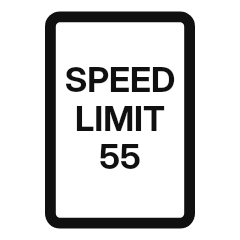
22. Heavy rain has left standing water on the road where this sign is posted. What does the law expect of the driver?
Show answer
Answer C: Driving below the posted figure, at a speed that suits the conditions
Drivers must adapt to conditions, so in rain, fog, snow or dense traffic the safe speed falls below the posted maximum and keeping to that maximum can itself be an offense.
-
23. A pedestrian steps off the curb in the middle of a block where there is no crosswalk at all. What is the legal position?
Show answer
Answer A: They must yield to you, but you must still avoid a crash
A pedestrian crossing away from a crosswalk yields to vehicles, yet every driver still has a duty to use care and avoid hitting a person.
-
24. In a normal signal cycle, what comes after a steady red indication?
Show answer
Answer A: A green indication that starts the next movement
Yellow is a warning that a movement is ending, so it never precedes a green; a red is followed by a green or a green arrow.
-
25. The circular sign shape is reserved for which warning?
Show answer
Answer C: Advance warning of a highway-rail grade crossing
A round yellow sign with a black X and the letters RR is the grade crossing advance warning sign, and the circular outline is used for no other message.