
Maryland MVA Permit Practice Test 31
- Questions25
- Correct to pass22
- Passing score88%
- Minimum age15 years 9 months
-
1. An overhead lane-use control signal shows a steady red X above the lane you are traveling in. What does it require?
Show answer
Answer D: Leave that lane, because it is closed to you
A steady red X means road users are not permitted to use the lane beneath it, so you must move into a lane that is open.
-
2. The road ahead is broken up with potholes and rough patches. What should you do?
Show answer
Answer C: Slow down, since a hole hit at speed can wreck a tire or wheel
A lower speed cuts the impact on tires, wheels and suspension and gives you time to choose a line through the rough surface.
-
3. What does it mean to scan the road while driving?
Show answer
Answer A: Moving your eyes constantly over the road, the sides and the mirrors
Scanning keeps information coming in from every direction, while a fixed stare leaves you blind to everything else.
-
4. A pedestrian steps off the curb without looking your way. What should you assume?
Show answer
Answer B: That the person has not seen you at all, and be ready to stop for them
Defensive driving means assuming you have not been seen until there is clear evidence that you have.
-
5. You reach a stretch of road covered by moving flood water of unknown depth. What is the correct decision?
Show answer
Answer D: Turn around and take another route
About a foot of moving water is enough to carry away most cars, and the roadbed under the water may already be washed out, so the only safe choice is to turn around.
-
6. You pass into a work zone with a reduced speed limit but you see no workers. What speed applies?
Show answer
Answer D: The posted work zone limit, whether or not workers are present
A posted work zone speed limit is a regulatory limit in force at all times, and narrow lanes and uneven surfaces remain dangerous when nobody is working.
-
7. What should you do before leaving a parked vehicle unattended?
Show answer
Answer C: Set the parking brake, place the transmission in park or in gear, switch off the engine and take the key
Securing the vehicle with the parking brake, the transmission and the ignition prevents it from rolling away and from being moved by someone else.
-
8. What is a Maryland driver's first duty when approaching a covered stopped vehicle from the rear?
Show answer
Answer B: Move into a lane that is not immediately adjacent to it, if that is practicable
Maryland asks the driver first to make a lane change into an available lane that is not immediately adjacent to the stopped vehicle, with due regard for safety and traffic conditions.
-
9. You have just had bad news and you feel very upset. What should you do?
Show answer
Answer B: Wait until you have calmed down, or else let somebody else drive
Strong emotion takes attention away from the road as surely as alcohol or fatigue, so it is a reason not to drive yet.
-
10. The cars in front of and behind your parallel parked car have left you very little room. How do you get out?
Show answer
Answer D: Ease back and forth, turning the wheels each way, until you clear
Short movements with the wheels turned first one way and then the other walk the car out of a tight space without touching anything.
-
11. On an undivided two-lane road you meet a school bus coming toward you with its red lights flashing and its stop arm out. What must you do?
Show answer
Answer C: Stop and wait until the red lights stop flashing
On an undivided road drivers in both directions must stop for a school bus loading or unloading, because children may cross in front of it.
-
12. You park on level ground in a lot. Where should the front wheels be pointing?
Show answer
Answer C: Straight ahead, so the car would not veer if it moved
On the level the wheels go straight so that the car stays in its own space, and so that a shunt from behind does not send it across a lane.
-
13. A large truck ahead of you in a roundabout is using part of both lanes as it goes around. What is the correct response?
Show answer
Answer B: Stay back and give it room until it leaves the roundabout
Long vehicles need extra width to get around the central island, so drivers behind must hold back rather than share the space beside them.
-
14. You are about to pass a long tractor-trailer on a two-lane road. What should you expect?
Show answer
Answer B: You will need more clear road, since the vehicle is much longer
A tractor-trailer can be 70 feet long, so passing it takes more distance and more time than passing a car at the same speed difference.
-
15. How high may a Maryland local authority raise a speed limit inside an urban district after an engineering and traffic investigation?
Show answer
Answer C: To no more than 50 miles per hour
Maryland caps a local increase inside an urban district at 50 mph, while a decrease is not subject to that ceiling.
-
16. What should you do before you back out of your own driveway at home?
Show answer
Answer A: Walk around the vehicle and check behind it for children or objects
A small child, a bicycle or a toy can sit entirely inside the blind area behind a vehicle, and a walk-around is the only way to be sure it is clear.
-
17. A motorcycle ahead of you is weaving slightly as it crosses a stretch of grooved pavement. What should you do?
Show answer
Answer D: Give the rider extra room until the surface improves
Grooves, metal plates and loose material affect a motorcycle far more than a car, so back off and let the rider deal with the surface.
-
18. How may a two-way left-turn lane never be used?
Show answer
Answer B: As a through travel lane or a passing lane
The lane exists only for turning movements, so traveling or passing along it puts you head-on with vehicles turning from the opposite direction.
-
19. You are backing straight down a driveway while looking over your right shoulder. Where should your left hand be?
Show answer
Answer C: At the top of the steering wheel, holding it with a firm grip
With one hand at the top of the wheel you can hold a straight course and make small corrections while your body is turned to look behind.
-
20. A yellow sign reads SOFT SHOULDER. What is it telling you?
Show answer
Answer C: The shoulder may not carry the weight of a vehicle
A soft shoulder is unpaved and can let a wheel sink, so a driver who leaves the pavement there may lose control or become stuck.
-
21. You are backing a trailer and want its rear to move to the left. Which way should you turn the steering wheel?
Show answer
Answer A: Move the bottom of the wheel to the left, which turns the top to the right
A trailer moves opposite to the tow vehicle's steering when backing. Holding the wheel at the bottom and moving your hand in the direction you want the trailer to go makes this easier.
-
22. A barricade carries a sign reading ROAD CLOSED TO THROUGH TRAFFIC. What does it permit?
Show answer
Answer B: Local access for people whose destination is on that road
This closure keeps out drivers who are only passing through while still allowing residents and deliveries to reach addresses within the closed section.
-
23. A yellow sign shows a truck on a slope with the legend 7 PERCENT GRADE. What should a driver of a heavy vehicle do?
Show answer
Answer A: Select a lower gear before starting down
The percentage shows how steep the descent is, and choosing a low gear at the top lets the engine hold the vehicle back instead of the brakes overheating.
-
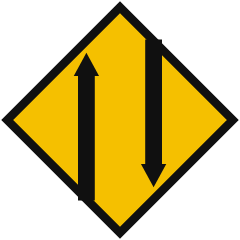
24. Which action becomes clearly more risky beyond this sign?
Show answer
Answer A: Using the left side of the roadway to overtake
With vehicles coming the other way on the same pavement, overtaking on the left needs enough clear road to pull out, pass and return, which is often not available.
-
25. You have passed a large truck and want to move back into its lane. What should you see first?
Show answer
Answer B: Both of its headlights in your rear-view mirror
Seeing both headlights in your mirror means you are far enough ahead to be out of the truck's front no-zone before you move over.