
Maryland MVA Permit Practice Test 11
- Questions25
- Correct to pass22
- Passing score88%
- Minimum age15 years 9 months
-
1. There is a driveway and a side street between you and the corner where you will turn right. When should you signal?
Show answer
Answer C: After passing the openings, so nobody pulls out in front of you
A signal switched on before an opening tells drivers waiting there that you are turning in, and they may pull out into your path.
-
2. The lane you are in has a right-turn-only arrow painted on the pavement. What must you do?
Show answer
Answer C: Turn right, because a lane-use arrow is a legal requirement
Lane-use arrows painted on the pavement are regulatory markings, so a driver in that lane must travel in the direction shown.
-
3. You are driving forward into a perpendicular space with a large pickup parked on the right of it. How should you take it?
Show answer
Answer D: Stay wide, turn in late and keep clear of the pickup
Starting the turn later keeps the rear of your car away from the vehicle beside the space, which is exactly what a tight early turn clips.
-
4. What does a sign reading Slower Traffic Keep Right require?
Show answer
Answer C: Traffic moving slower than the general flow must use the right-hand lane
The sign applies to any vehicle traveling below the speed of the traffic around it, which must keep right so faster vehicles can use the lanes to the left.
-
5. You are making a U-turn at a signal on a green left arrow. Who must you still watch for?
Show answer
Answer D: People in the crosswalk you will cross as you come around
Even a protected arrow does not clear the crosswalk, and a U-turn sweeps across a crosswalk that pedestrians may already be using.
-
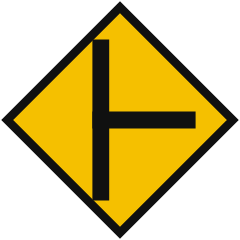
6. What condition does this sign warn a driver about?
Show answer
Answer B: Another road joins the road being traveled, from one side
It announces a side road entering the main roadway, so the driver should expect vehicles waiting to pull out and other vehicles slowing to turn in.
-
7. How should your following distance change in heavy rain?
Show answer
Answer D: It should be increased well beyond what you use on dry pavement
Wet pavement lengthens stopping distance and rain cuts visibility at the same time, so a larger gap gives you the extra seconds needed to see a problem and stop for it.
-
8. What must you be sure of before you pull out to pass on a two-lane road?
Show answer
Answer A: That the road ahead is clear far enough for the whole pass
You need enough clear road to pull out, pass and return before any oncoming vehicle arrives, and you must judge that distance before you start.
-
9. How much of a traffic lane is a motorcycle entitled to use?
Show answer
Answer D: The full width of the lane
A motorcycle is entitled to the full lane, and riders move within it to stay visible and to avoid surface hazards, so drivers should never try to share a lane with one.
-
10. Why does even a small reduction in speed matter so much where people are walking?
Show answer
Answer D: Because a pedestrian struck at a lower speed is far more likely to survive
The chance that a pedestrian survives falls steeply as impact speed rises, so a few miles per hour can decide the outcome.
-
11. Below a speed limit sign is a smaller panel with white numbers on a black background and the word NIGHT. What does it show?
Show answer
Answer D: The limit that applies after dark
A night speed limit panel sets a separate legal maximum for the hours of darkness, and its reversed colors mark it as the night figure.
-
12. In heavy fog at night on a rural two-lane road, which marking best helps a driver hold position?
Show answer
Answer C: The solid white line along the right edge
Steering by the right edge line keeps a driver clear of oncoming traffic, while watching the center line tends to pull the vehicle toward it.
-
13. A crash happens directly in front of you and vehicles are blocking both lanes. What should you do?
Show answer
Answer B: Stop at a safe distance, put on the hazards and warn the traffic behind
The greatest danger after a crash is a second collision, so stop short of it and make sure the traffic behind you can see the problem.
-
14. The vehicle in front of you has stopped and is waiting to turn left, and there is a paved shoulder to the right. May you use it to get by?
Show answer
Answer D: No, in most states a pass may not be made by leaving the paved travel lanes
Passing on the right is normally lawful only inside the marked travel lanes, and most states prohibit driving onto the shoulder to get around a turning vehicle; the few states that allow it attach strict conditions.
-
15. You are stopped in a shared through and right-turn lane with your right signal on, and a bicyclist rides up along your right side. What should you do?
Show answer
Answer A: Let the bicyclist clear the intersection or move ahead before you turn
A cyclist alongside your right side is in the path your turn will sweep across, so wait until that space is clear before turning.
-
16. You are traveling beside a solid white lane line. What does it tell you?
Show answer
Answer B: Crossing it is discouraged or prohibited, so stay in your lane
A solid white line separates lanes going the same direction where lane changing is discouraged or prohibited, such as where a through lane meets a mandatory turn lane.
-
17. Freeway traffic ahead of you has come to a stop. Besides braking early, how can you warn the drivers behind you?
Show answer
Answer B: By switching on the hazard lights for a few seconds
A short burst of hazard lights is a recognized way to tell following traffic that the queue ahead has stopped, and it carries much further back than brake lights. Some states restrict hazard lights on a moving vehicle, so use them only for the moment you are slowing.
-
18. An overhead lane signal shows a flashing yellow X above your lane. What does it mean?
Show answer
Answer D: The lane may be used only for a left turn
A flashing yellow X marks a lane that may be used only to make a left turn; a steady yellow X is the one that warns you to leave the lane.
-
19. When should you move into the lane you need for a turn?
Show answer
Answer D: Well before the intersection, as soon as you know your route
Getting into the correct lane early lets other drivers read your intentions and keeps you from making a sudden lane change at the corner.
-
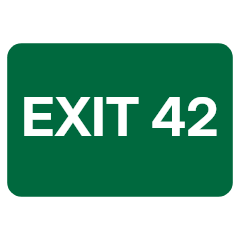
20. A driver in the left lane of a freeway realizes only when level with this sign that the ramp beside it is the one they need. What is the correct action?
Show answer
Answer A: Carry on to the next interchange and turn back from there
There is no safe way back to a ramp once it has been reached from the wrong lane, so the driver keeps going to the next interchange, where the ramps are built for that movement.
-
21. You are in a minor collision on a busy road. No one is hurt and both vehicles can be driven. What is the recommended thing to do?
Show answer
Answer C: Move the vehicles out of the travel lanes to a safe spot before exchanging information
Vehicles left in traffic after a minor crash invite a second, often worse, collision. Clearing the lane protects everyone, and you still exchange details and report as required.
-
22. In heavy stop-and-go traffic, why does using both lanes right up to a merge point help?
Show answer
Answer D: It stores the queue in two lanes, so the backup is shorter
Filling both lanes halves the length of the queue and keeps it away from the traffic upstream, which is why alternating at the merge point works better when traffic is slow.
-
23. How much following distance should you keep behind a motorcycle?
Show answer
Answer C: At least three to four seconds
A motorcycle can slow or stop very quickly and is easily upset by a surprise, so allow three to four seconds instead of the usual car gap.
-
24. The divided highway ends warning sign means that
Show answer
Answer D: the median separating the directions ends and the road returns to two-way operation
Beyond this sign opposing traffic is no longer separated by a median, so the driver must keep right and expect vehicles approaching in the adjacent lane.
-
25. You come around a bend and find loose sand spread across your lane. What should you do?
Show answer
Answer D: Ease off the gas, avoid sudden braking or steering, and keep straight
Loose material acts like ball bearings under the tires; smooth inputs preserve what little grip remains, while sudden braking or steering breaks it.