
Maryland MVA Permit Practice Test 1
- Questions25
- Correct to pass22
- Passing score88%
- Minimum age15 years 9 months
-
1. A yellow pennant-shaped sign is posted on the left side of a two-lane road facing you. What is it telling you?
Show answer
Answer B: You are entering a no-passing zone and may not start a pass
The pennant is placed on the left so that it faces the driver who might pull out, and it marks the beginning of a no-passing zone.
-
2. A broken white line separates your lane from the lane on your right. What does it permit?
Show answer
Answer C: Changing lanes when it is safe to do so
A normal broken white line marks a boundary between lanes traveling the same way that road users may cross when it is safe.
-
3. A line of short dashes set closer together than an ordinary lane line runs beside your lane where a ramp leaves the highway. What does a dotted line of that kind convey?
Show answer
Answer A: A warning that the lane is about to change function
Dotted lines give guidance or warning about a downstream change, such as a lane that becomes an exit only lane or a lane line carried across an intersection.
-
4. You are on an entrance ramp joining a busy freeway. What should you do with your speed in the acceleration lane?
Show answer
Answer D: Build it up to about the speed of the traffic you are joining
Merging works when your speed matches the traffic stream, because a large speed difference forces the drivers already on the freeway to brake or swerve.
-
5. How long should a young child ride in a rear-facing child seat?
Show answer
Answer D: Until the child outgrows the height or the weight limit of the seat
Rear facing is the safest position and should be kept until the child reaches the top height or weight allowed by the seat.
-
6. How long must a Maryland learner's permit holder under 19 hold the permit before taking the skills or road examination?
Show answer
Answer A: At least 9 months
Maryland requires an applicant under 19 to wait at least 9 months from the date the permit was first obtained, while applicants aged 18 with a diploma or 19 to 24 wait 3 months and applicants 25 and over with a clean record wait 45 days.
-
7. Your parking brake no longer holds the car on a slope. What should you do?
Show answer
Answer D: Have it repaired, and until then park only on level ground
A parking brake that will not hold is a defect to be fixed; avoiding grades in the meantime keeps the vehicle from rolling away.
-
8. How much clear road do driver manuals say you need before starting a pass at highway speed on a two-lane road?
Show answer
Answer C: Enough to complete the pass and return, roughly ten to twelve seconds of travel
At highway speed the whole maneuver of pulling out, overtaking and returning takes roughly ten to twelve seconds, and every foot of that has to be visible before you start.
-
9. When is passing another vehicle on the right generally permitted?
Show answer
Answer C: When the road has two or more lanes in your direction, or the vehicle ahead is turning left and there is room without leaving the pavement
Passing on the right is limited to situations where a lawful lane exists for it or the vehicle ahead is turning left, and it may never be done by driving onto the shoulder.
-
10. On a two-lane road with a broken yellow center line, may you cross it to turn into a driveway on the left?
Show answer
Answer C: Yes, when it is safe and the oncoming lane is clear
A broken center line may be crossed for a pass or for a left turn into a road or a driveway, once the oncoming lane is clear.
-
11. Another driver has pulled out to pass you. What should you do?
Show answer
Answer A: Stay in your lane, keep your speed steady or ease off, and let the pass finish
Accelerating while being passed forces the other driver to stay in the opposing lane longer, so the safe response is to hold or slightly reduce speed and stay right.
-
12. You reach a red light with a sign reading NO TURN ON RED. What may you do?
Show answer
Answer D: Wait for the green; no turn is allowed while the light is red
That sign removes the usual permission to turn on red at the intersection, so you must wait for a green indication.
-
13. A driver is following you far too closely and you have a turn coming up. How should you slow down for it?
Show answer
Answer B: Signal early and slow gradually well before the turn
Early signals and gentle braking give a tailgater the time and distance they have failed to leave for themselves.
-
14. Your vehicle breaks down on a busy highway. What is the safest course of action?
Show answer
Answer D: Get it as far off the roadway as possible, switch on the hazard lights and keep clear of the traffic lanes
A vehicle left in or beside a travel lane is a hazard, so move it well off the road, make it conspicuous with hazard lights and keep yourself away from passing traffic.
-
15. A driver reaches this sign and the intersecting roadway is completely clear. What is required?

Show answer
Answer D: Slowing to a speed that allows stopping, then going on without stopping if the way stays clear
This control asks the driver to slow down and be ready to stop, and a full stop becomes necessary only when traffic or pedestrians would otherwise be interfered with.
-
16. A yellow diamond showing two vertical arrows, one pointing up and one pointing down, warns that
Show answer
Answer A: the road ahead carries traffic in both directions
The two-way traffic sign warns that the roadway ahead is not divided and that vehicles will be coming from the opposite direction.
-
17. The stability control warning light flashes while you are driving through a curve. What does it mean?
Show answer
Answer A: The system is actively working to keep the vehicle under control, so slow down
A flashing stability control light means the system is braking individual wheels because you are near the limit of grip. Ease off and drive more gently.
-
18. You are starting from a stop on a snowy, icy street and the drive wheels begin to spin. What should you do?
Show answer
Answer C: Ease off the accelerator and start again more gently
Spinning tires polish the surface and dig in. Very gentle pressure on the accelerator, and a higher gear if you have one, gives the tires the best chance to grip.
-
19. You have finished parallel parking at the curb. How should the vehicle sit?
Show answer
Answer A: Close to the curb, so that it does not stick out into the traffic lane
A parked vehicle must sit close enough to the curb that it does not intrude into the path of passing traffic; the exact maximum distance is set by each state.
-
20. Your headlights suddenly go out while you are driving at night. What should you do?
Show answer
Answer A: Try the dimmer switch and the headlight switch, turn on the hazard lights and pull off the road
Switching between high and low beams or cycling the light switch sometimes restores the lights. If not, use the hazard and parking lights to get off the road safely.
-
21. Where should the lap part of the seat belt sit?
Show answer
Answer C: Low and snug across the hips, touching the tops of both of the thighs
The hip bones can take crash forces, but the abdomen cannot, so the lap belt goes low and tight across the hips.
-
22. You are leaving a private driveway and entering a public street. What are you required to do?
Show answer
Answer B: Stop and yield to traffic on the street and to pedestrians on the sidewalk
A driver entering a roadway from a driveway, alley or private road must stop and yield to traffic on the roadway and to pedestrians on the sidewalk being crossed.
-
23. What should you check on the hitch before towing a trailer?
Show answer
Answer B: That the coupler is locked and the safety chains are crossed underneath
The coupler must be latched and pinned, and the chains crossed under the tongue so they cradle it if the coupling lets go.
-
24. No plaque stating days or hours accompanies this sign at the intersection. When does the restriction apply?
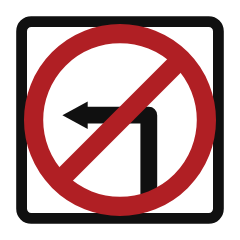
Show answer
Answer D: At all times, since nothing limits it to particular periods
A regulatory restriction runs continuously unless a supplemental plaque states the days or hours during which it applies.
-
25. How may a Maryland court respond to a first handheld telephone offense?
Show answer
Answer B: It may waive the penalty if the driver proves a hands free accessory was obtained
Maryland lets the court waive the penalty for a first offense if the driver shows proof of acquiring a hands free accessory, attachment, add-on or built-in feature.